





Why your AC compressor won't kick on in Mississippi

Step 1 of 3: Equipment

Why won't my AC compressor kick on?

It's hot, the air handler might be blowing, but the outside unit sits quiet. In Mississippi, that's not something to wait out. A compressor that won't start can mean a bad capacitor, a tripped high pressure switch, a failed contactor, or a unit that's locked up and tripping its breaker. Some causes are a quick fix. Others mean the compressor itself is done.

Usually a bad capacitor, a stuck contactor, or a tripped safety switch

The compressor needs a jolt from the start capacitor to get moving, and a weak one won't deliver it. You'll sometimes hear the outdoor fan running while the compressor hums or stays silent. A contactor with pitted or burnt contacts won't close the circuit at all, so nothing outside turns on. The unit may also be shutting itself down on purpose. Mississippi summers push these systems hard for months, and a compressor running long hours against high heat and humidity can trip its high pressure or overload switch to protect itself. If the breaker keeps tripping when it tries to start, the compressor may be seizing, and that's a bigger repair than a part swap.

A gray-haired man in a dark sweater sits on a light gray sofa in a living room, looking toward a sunlit window with trees outside.
A gray-haired man in a dark blue sweater sits on a light gray sofa in a sunlit living room, looking off to the side, with a potted plant, shelving unit, and large glass doors behind him.
A bearded man with graying hair in a dark green sweater sits on a sofa in a living room, looking off to the side, with a sliding glass door and a dim kitchen doorway behind him.
A gray-haired man in a dark knit sweater sits on a light gray sofa in a living room, looking toward a sunlit window, with houseplants, a lamp, and framed art in the background.

What are you noticing at the outdoor unit right now

Go outside and listen. The fan on top might be spinning, or the whole unit might be dead silent. You may hear a single click or hum followed by nothing, which usually means the compressor is trying to start and can't. Sometimes there's a faint burning smell near the unit, or the breaker for it has tripped on its own. Inside, the air handler keeps running, so vents still move air, just warm air. Left alone through a Mississippi summer, a compressor that struggles to start can fail completely, and a short cycling compressor can burn out wiring or trip the breaker repeatedly until someone shuts it down for good.

A gray outdoor air conditioning condenser unit on a concrete pad beside a house with horizontal gray siding, with a wall-mounted electrical disconnect box and insulated refrigerant lines, and blue hydrangeas in a mulched bed to the left.

Fan spinning, unit running quiet and steady

This is what a healthy outdoor unit looks like. The fan turns, the compressor hums along underneath it, and the lines running into the wall stay cold to the touch. No clicking, no buzzing, no shutting off after a few seconds.


A gray outdoor air conditioner condenser unit on a concrete pad beside a house with beige horizontal siding, with an electrical disconnect box and insulated refrigerant lines on the wall and dry leaves on the ground.

Rust on the shroud, dirt packed in the fins

A unit that looks like this has likely been fighting the heat for years. Rust on the fan shroud and dirt caked into the fins make the compressor work harder to shed heat, and that strain is often what finally keeps it from starting at all.

An outdoor air conditioner condenser unit on a concrete pad beside a house with horizontal lap siding, with a gray electrical disconnect box and conduit on the wall and a green shrub over pine-needle mulch at left.
Before you get your air conditioner repair
A gray outdoor air conditioner condenser unit on a concrete pad beside a house with light vinyl siding, with an electrical disconnect box and conduit on the wall and a leafy shrub with dark mulch to the right.
After you get your air conditioner repair

When your thermostat calls for cooling, it sends a low voltage signal out to the outdoor unit. That signal reaches a contactor, a switch with a coil that pulls its contacts closed and lets full power flow to the compressor and fan. Starting a compressor takes more than just closing a switch, though. The compressor has to start spinning against refrigerant pressure that's already built up inside it, and that takes a hard jolt of power. A capacitor sitting next to the contactor supplies that jolt. If the capacitor has weakened, you might hear the compressor hum for a second as it tries, then cut out. There are also safety switches built into the refrigerant lines that watch for pressure that's too high or too low. If either one trips, it cuts power to the contactor directly, so the compressor won't start even though every wire and part upstream is working fine. Even dirt or corrosion built up on the contactor's points can keep the circuit from closing at all, which means the compressor never sees power in the first place.

How the compressor actually starts

  • The thermostat calls for cooling and sends low voltage power to a contactor inside the outdoor unit.
  • The contactor is a switch with a coil that pulls a set of contacts closed, and that's what actually starts the compressor and fan.
  • A capacitor sits next to the contactor and gives the compressor the jolt of power it needs to start spinning against the pressure already inside it.
  • If the capacitor has gone weak, the compressor may hum for a second and then shut off instead of starting.
  • A high pressure or low pressure switch in the refrigerant lines will cut power to the contactor if the system senses something wrong, even if everything electrical is fine.
  • Dirt or corrosion on the contactor points can stop the circuit from closing at all, so power never reaches the compressor even though the thermostat is calling correctly.
A middle-aged woman with shoulder-length dark hair, wearing a gray cardigan over a cream top, sits in an upholstered armchair and looks toward a sunlit window, with a shelf holding framed pictures and a plant behind her.
A woman and a child wrapped together in a knitted gray blanket on a couch, with the child's head resting on her shoulder and a lit table lamp and houseplant in the background.

One form, no calling around

Your request goes to one pro, not a list of companies.

It costs nothing to send, and you don't have to hire anyone.

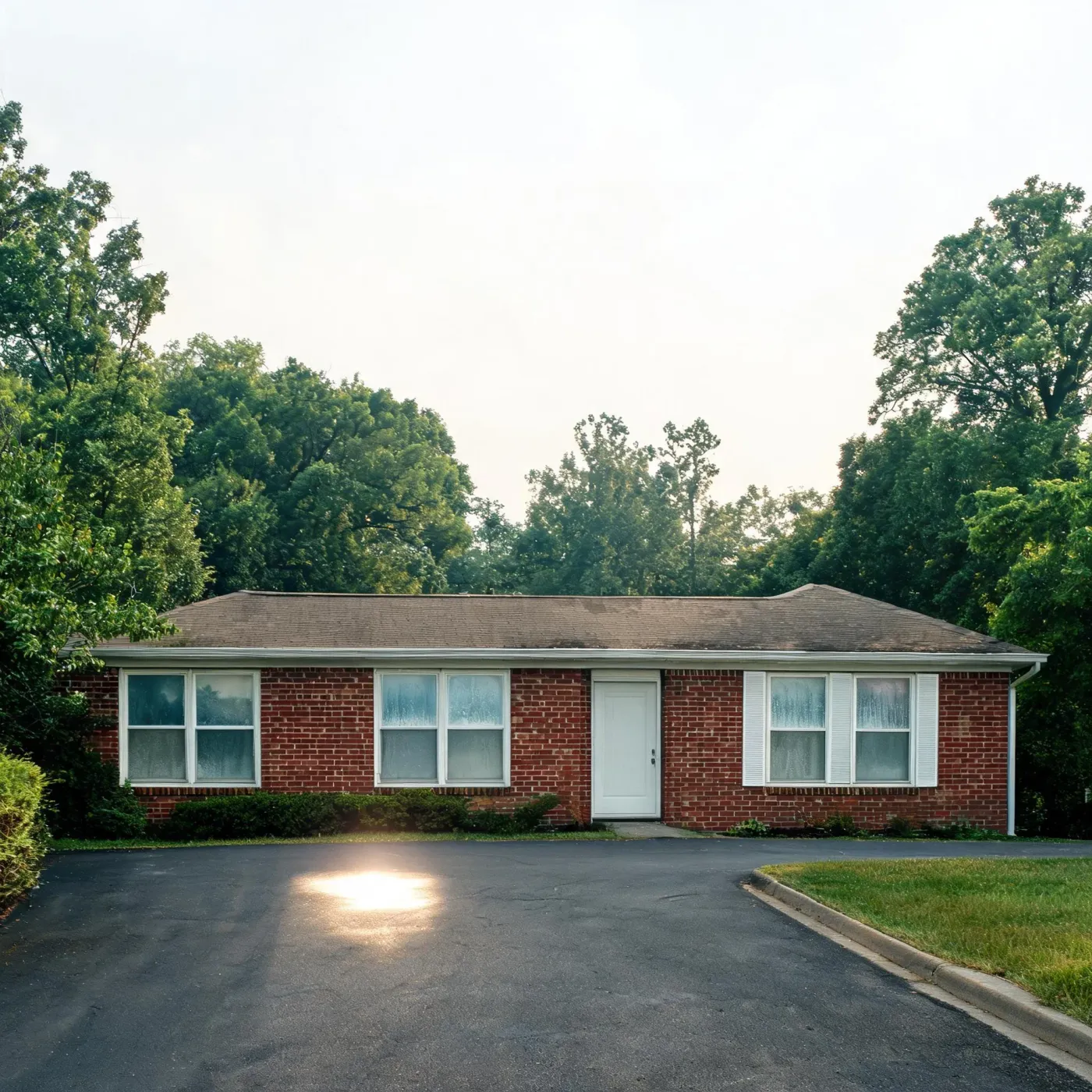
A single-story red brick ranch house with a white door, white-trimmed windows and a shingled hip roof, fronted by a wide asphalt driveway with sunlight glare, surrounded by green deciduous trees under a pale sky.

Summer air here averages a dew point of 70°F across June, July and August, according to NOAA climate records. That's heavy, sticky air, and it means your compressor isn't just cooling, it's working to wring water out of the air every time it runs. That load falls hardest on the parts that start the compressor up: the capacitor and the contactor. A capacitor that's weakening might get the unit through a mild April afternoon and still fail on a July day when the air is this thick. If your outside unit has gone quiet during a stretch like that, the heat and humidity are likely what pushed a marginal part past the point it could still do the job.

NASA POWER T2MDEW county cells weighted by homes

A gray outdoor air conditioning condenser unit on a concrete pad beside a house with horizontal lap siding, with a wall-mounted disconnect box and conduit to the left and a green shrub with mulch to the right.
A clean condenser with clear airflow around the coil fins lets the compressor shed heat the way it was designed to.
A dirty outdoor air conditioning condenser unit on a concrete pad beside a house wall with horizontal siding above a painted brick foundation, with a gray electrical disconnect box and conduit on the wall.
Coil fins packed with dirt and grime trap heat against the compressor, and that's a common reason it won't start or trips off.
  1. Thermostat calls for cooling and sends voltage to the contactor.

  2. Contactor coil pulls its contacts closed to energize the circuit.

  3. Capacitor delivers a jolt of power to start the compressor motor.

  4. Run capacitor keeps steady power flowing to the compressor while it operates.

A closed silver laptop and a glazed ceramic mug on a wooden table, with a blurred kitchen counter, potted plant, cutting board and window in the background.

What a dead compressor means for your house in August

If the compressor won't start, the air handler can still blow, so the vents feel like something is working. What comes out is room temperature air moving through a house that's already picking up heat and humidity. In Mississippi that happens fast. A couple of hours with no compressor and you'll feel the air go heavy, especially in rooms with less insulation or more windows.

Finding someone qualified to look at a sealed system component like a compressor isn't like calling a handyman. You'd normally be checking licenses, asking who actually works on your brand of condenser, and fielding a few quotes before you know who to trust in your house. Here you get matched with one licensed contractor local to your part of Mississippi, someone who sees this exact failure every summer and knows what to check first, without the back and forth of explaining the problem to five different companies.

A living room corner with a beige sofa and cushion, a round wooden coffee table holding a pale ceramic vase of eucalyptus stems and a wooden bowl, and a curtained window with a potted plant above a latticed radiator cover in the background.

Power costs 14.03 cents per kilowatt-hour statewide

At 14.03 cents per kilowatt-hour, a compressor that short cycles or keeps tripping off runs up your bill without ever cooling the house. A fix that gets it starting clean again is what keeps that draw in check.

EIA-861 2025 statewide residential average

An outdoor air conditioner condenser unit sits on a concrete pad beside a shingled house wall, surrounded by mulch, broad-leaved shrubs and a lawn in low evening light.

By seven that evening the light had gone gold and low over the yard, the kind of light that usually means the worst of the heat is letting up. It hadn't. You walk out past the grill to check on the unit because the house still feels thick, and that's when you see it. The fan on top isn't moving. No hum, no click, nothing. You crouch down near the vents on the side, waiting for some sound to start it up, but it just sits there in the grass, quiet, while the air handler keeps pushing warm air through the house behind you.

A compressor that won't start almost always comes down to one of a few things: a bad capacitor, a tripped high pressure switch, a failed contactor, or a motor that's seized. None of those are guesswork once someone's hands are on the unit with a meter. What it isn't is a job for trial and error, swapping parts and hoping, while your house keeps climbing into the 80s. The contractor who gets matched to you works on this equipment all summer in this climate, in this heat and this humidity, and knows which of those parts tends to go first and why. You're not getting a list of companies to call and compare, you're getting one licensed contractor local to you, so your phone isn't ringing off the hook with sales pitches while you're trying to get your house cool again. The outdoor unit is either going to need a part replaced or it's going to need a closer look. Either way, you now know what the quiet is telling you, and you know who to put in front of it.

A house roofline with a stone chimney rises above trees, with a tall pine, Spanish-moss-draped oak branches, and misty hills in the background.

Skip the search

Skip the search

No charge to send it. You decide if you hire them.

You've already checked the breaker and the thermostat. The next step is getting someone local to put a meter on the unit instead of guessing at parts. One call gets you a contractor who works on compressors like this all summer, not a list of strangers to screen yourself.